Locked and Loaded: How Fish Table Shooters Are Turning Chance Into a Target-Rich Experience
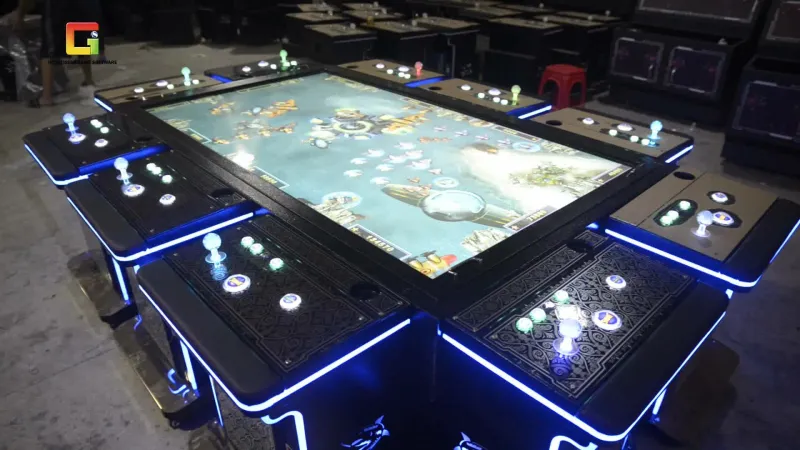
Photo: arcade fish shooting game table with glowing screen and joysticks, via img.alicdn.com
Walk into certain strip-mall arcades from Florida to California and you'll see it: a big glowing table, four players crowded around it with mounted joysticks and rapid-fire buttons, blasting schools of brightly colored fish swimming across a giant screen. Every fish has a dollar value. Bigger catch, bigger payout. It looks like a carnival game. It plays like an arcade shooter. And legally? That's where things get murky.
Welcome to the fish table — the genre that's quietly becoming one of the most interesting stories in American gambling.
From Overseas Gambling Halls to the American Strip Mall
The fish table (and its cousin, the fishing-shooter video slot) traces its roots to Asian gaming halls, where fishing arcade games became a phenomenon in the 2010s. These weren't traditional slot cabinets — they were full tables with seats, guns, and screens full of sea creatures drifting around in real time.
The games migrated with diaspora communities, popping up in arcades and parlors in California, Texas, Georgia, and beyond. Then online casinos and sweepstakes-style platforms got hold of the format, and suddenly fishing shooters were everywhere — no joystick required, just a tap on your phone.
The hook (sorry) is simple: instead of pulling a lever and waiting, you're doing something. You aim. You fire. You pick your target. Every shot costs credits, and every fish carries a prize multiplier. The octopus might pay 50x. The golden dragon? Life-changing, if you can drop it before it swims off-screen.
The Skill Question That Keeps Lawyers Up at Night
Here's where it gets spicy. Slots are pure chance — that's settled law in every US state. But fish tables feel like skill games. You're shooting, after all. Doesn't aim matter?
Sort of. Mostly. It's complicated.
In most fish tables, the payout odds are governed by an RNG behind the scenes, just like a slot. Your bullets connect or don't based on programmed probabilities, not your reflexes. But because there's a visible skill layer — targeting, timing, choosing which fish to chase — regulators have spent years arguing about what these things actually are. Some states have banned them outright, calling them disguised gambling devices. Others allow them in arcades with payout caps. A few just haven't figured out what box to check yet.
That ambiguity is the genre's superpower and its Achilles' heel. It lets operators market them as games while players treat them like slots — and it lets the games evolve faster than the rulebooks can keep up.
Why Gamers Are Eating It Up
Strip away the legal drama and the appeal is obvious, especially to the arcade-generation crowd. Fish tables hit the same nerves as the classics:
- Agency: You're never just watching reels spin. You're making decisions, even if the math underneath doesn't care.
- Spectacle: These are the loudest, brightest, most chaotic games on any floor. Screen-shaking explosions, swarming bosses, bonus rounds where the whole table teams up on a whale.
- Social play: Unlike a slot, you're sitting next to other players, all shooting at the same screen. Trash talk is mandatory. We don't make the rules.
- Session rhythm: Small frequent shots, occasional big takedowns — it scratches the same itch as a fast-paced slot session, just with more finger movement.
It's basically what happens when a shoot-'em-up and a slot machine have a very loud baby.
The Online Migration Is Already Happening
The next frontier isn't the strip-mall parlor — it's your phone. Online versions of fishing shooters are showing up across casual gaming and sweepstakes platforms, adapted for touchscreens with tap-to-fire controls and auto-target modes. The core loop survives intact: spend credits, shoot fish, chase multipliers.
For a site like FPlay77 — built for players who grew up on arcade cabinets and like their entertainment fast and flashy — the fishing-shooter genre is a natural fit. It's the arcade spirit that runs through everything here, turned up to eleven and pointed at the open ocean.
A Word to the Wise
One honest note before you man the cannons: the skill flavor is mostly flavor. The house edge lives in the math, same as any slot, and no amount of marksmanship changes it. Treat it like any other game of chance — set a budget, enjoy the chaos, and don't convince yourself you've cracked the code because you bagged two octopuses in a row.
The reels taught us to love the spin. The fish tables are teaching us to love the shot. And if the last decade of gambling taught us anything, it's that the moment a game feels like play, players will show up — regulators, hold on tight.